Chapter 2 Knowing vs Believing — Go All The Way Now
The Reality of Knowing
“I believe, but I do not know.”
If I truly knew something, I would not say I believe it.
If I were riding a bicycle, I would not say: “I believe I am riding a bicycle,”
I would know it — without doubt.
The same applies to flying an airplane.
Before boarding, we want to know that the pilot knows how to fly — not that they merely believe they can.
In everyday life — drinking a glass of water, driving a car, standing on a rock, looking at forest — knowing is immediate and direct. No belief is required. There may be no witnesses, yet it is still known.
When somebody says “I believe”, they are really saying: “I do not know.”
Belief fills the gap where knowing has not yet arrived.
The Limitations of Belief Systems
Beliefs can be about anything.
That is both their beauty and their danger.
One person believes a currency is fully backed by gold.
Another believes it is not.
Both cannot be right.
The planet, however, is on one course only, governed by a single Creative Principle that brought everything into existence from what appears to be nothing.
Wether we understand it or not, creation is precise, lawful, and complete. Beyond belief.
Mostly we have science to thank for that, science being “an intellectual and practical activity, the systematic study of the structure and behavior of the physical and natural world through observation and experiment.”
Is the Sun turning around the Earth, or the Earth around the Sun?
Science does not ask what we prefer to believe.
It asks, or should be asking, what is?
The Grail Question
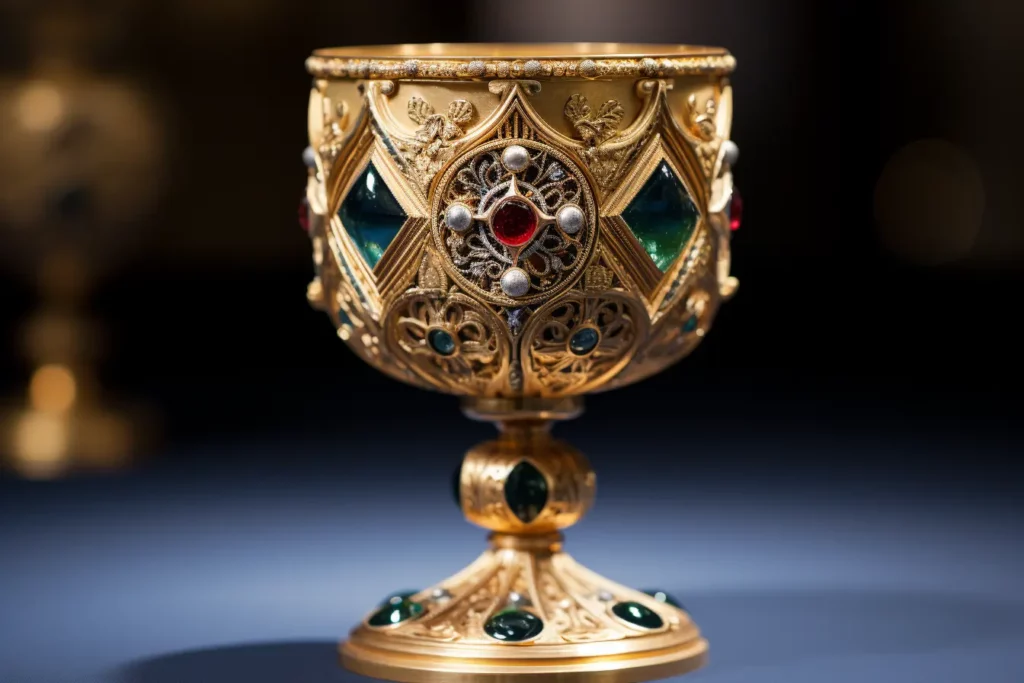
Consider the image of a jeweled cup.
We can see that it is a cup.
We may believe it is the Holy Grail.
But we do not know.
It could be a replica.
The stones could be fake.
The Grail itself may not even be a cup.
If it were real, would it belong only to one religion?
Or would it serve all of humanity?
We do not know.
Believing is not knowing
Questioning What we Believe
We often say, “I strongly believe”, as if strength makes belief more true.
It does not.
The Earth is round — yet some believe it is flat.
Humans are influencing climate change — or not.
Aliens are here — or not
Governments always tell the truth — or not.
History and some science can be filled with assumptions that later proved incomplete or false.
The Great Pyramid is officially dated at about 4600 years old — yet its precision and method of construction suggests knowledge and technology not acknowledged by mainstream timelines, Some researchers now suggest it may be far older.
The Egyptians as well as the Chinese were already there before the Great Flood — or not.
More on this in later chapters.
Jesus is reported to have said,
“I and the Father, are one, and you can be like me. What I have done all can do. What I am, all shall be.”
Did he say this?
If so, what does it mean.
According to esoteric texts such as the Aquarian Gospel, and now texts and videos available on the internet, Jesus in his youth, possibly spend years in study, and contemplation — attending mystery schools in Egypt, Greece, Persia, Ethiopia and India.
He may have passed through levels of awareness that few explore today.
We have been educated to believe we are limited beings — separate from the Source.
Yet if we are made in the image and potential of being an incarnation of the Creative Principle, the father of creation, then our potential must reflect that origin.
This does not require an immaculate conception.
It requires realization.
Near-death experiences reported across cultures point in the same direction — suggesting consciousness continues beyond the body after passing.
Belief alone cannot answer this.
Knowing may.
From Believing to Knowing
Knowing is not an opinion.
It is a realization.
If humanity truly knew the One Creative Principle — the Universal Mind — there would be no argument about it, no war about it, much like there is no argument about the force gravity the force of attraction keeping us on this planet and it going around the sun.
Science itself is approaching the understanding that creation arises from an intelligent, organizing consciousness, fundamental to creation — not random dust alone.
In the chapters ahead, this book and its practices invites you to move from believe into knowing — through direct inner alignment with that very intelligence.
Just as the body emerges from an almost invisible seed carrying the complete blueprint.
Consciousness too unfolds from an unseen source.
There is nothing accidental about it.
Belief is optional.
Knowing is transformative.
Peace as a State of Knowing
Listen closely to language when folks talk.
Notice the difference between saying: “I believe” or “I know”
Peace cannot exist as a belief.
It exists only as a non dual state of consciousness.
War cannot arise from Universal Consciousness, the all One.
It is not an option there,
Peace is non-dual.
Without sides.
Without locality.
Without negotiation.
Welcome to the possibility of Peace of Mind and Peace on this Planet by connecting our consciousness to the consciousness that created that Planet. Not any amount of enforcement or weaponry will do as we are proving on a daily basis right today.